
It started because Richard Mosse wanted to take photographs of flowers at night, and ended up as a three-year odyssey into the environmental crimes happening in the Amazon Rainforest.
Artist Richard Mosse sits in front of the 20 metre-long screen which is playing his new work, Broken Spectre.Credit:Eddie Jim
The Irish artist, known for his visually striking and political works, had recently finished Incoming, a project about the refugee crisis. It had involved a lot of time, travel and emotional investment. ”I was a bit burned out, especially because some of the things you witness are quite harrowing,” says Mosse. So, he took a step back and went to Ecuador’s cloud forest to photograph flowers and lichen and rotting leaves under ultraviolet light. The results were “rather eccentric,” he says with a laugh. It was while he was there that Jair Bolsonaro was elected to office in Brazil, “and that opened the floodgates in the Brazilian Amazon for environmental crimes”.
Creating Broken Spectre was the natural next step. Working with his long-term collaborators Australian composer Ben Frost and American cinematographer Trevor Tweeten, Mosse spent years travelling through the Amazon to create a portrait of an ongoing crisis. The result is an immersive, surreal and haunting film, which has its world premiere on Saturday.
Playing across a 20-metre-long screen in a darkened room in the National Gallery of Victoria, Broken Spectre opens on warm family scene – children playing outdoors, dishes being washed, a lot of smiles. Slowly, however, the mood shifts. The rainforest itself starts to come into view, and the crimes being visited upon it are gradually shown, one by one.
Visually it shifts between three different modes. Aerial shots show the forest in bright, unnatural colours, leaves glowing red, barren stretches of land in light purple. In between, there is occasional close up ultraviolet footage of flora and fauna, cracks and pops in the soundtrack lending the scenes an almost horror-movie edge. Tying all this together, however, are the people. Shot in black and white infrared, “it’s incredibly hard to work with,” reflects Mosse. “But it makes it makes the forest glow this white sort of violent white.“
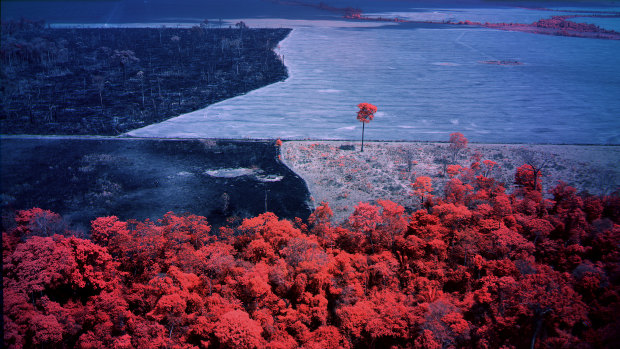
Broken Spectre 2022 (still). Courtesy of the artist and Jack Shainman
Gallery, New York.Credit:Richard Mosse
In the past, Mosse has attracted criticism for what has been perceived as prioritising aesthetics over subject matter. In Broken Spectre it is clear that this is not the case. The overhead views of the rainforest are eye-catching and beautiful, but there’s another layer, a story underneath the uneasy colouring. “Multispectral satellites are able to reveal quite a lot of information about environmental degradation, and many other things to do with the health of the rainforest,” explains Mosse. “It’s used widely, not just by scientists, but also by multinational business [and by] mining companies to understand where rare earth minerals are for extraction.”
Using this technology cuts to the crux of the film – looking at the push and pull between destruction and conservation. “The rainforest is a very resilient thing. But it’s at this point it’s so degraded and can’t heal itself. We’re on the tipping point of forest dieback where the forest can’t generate its own rain, and thereby stops being rainforest.”
The film is designed for a gallery, so you can step in at any point and stay however long you want, whether that be for a few moments or for the full 74 minutes. There is a narrative if you watch from beginning to end, but the individual scenes are each imbued with meaning, and even the experience of watching it nods to the immensity of the climate emergency. It’s impossible to take in the whole screen at once – sometimes there are two complementary but different scenes playing at once. What stands out most, however, are the people who have entrusted Mosse with their stories.
Originally published at Sydney News HQ


No comments:
Post a Comment